 Mantra
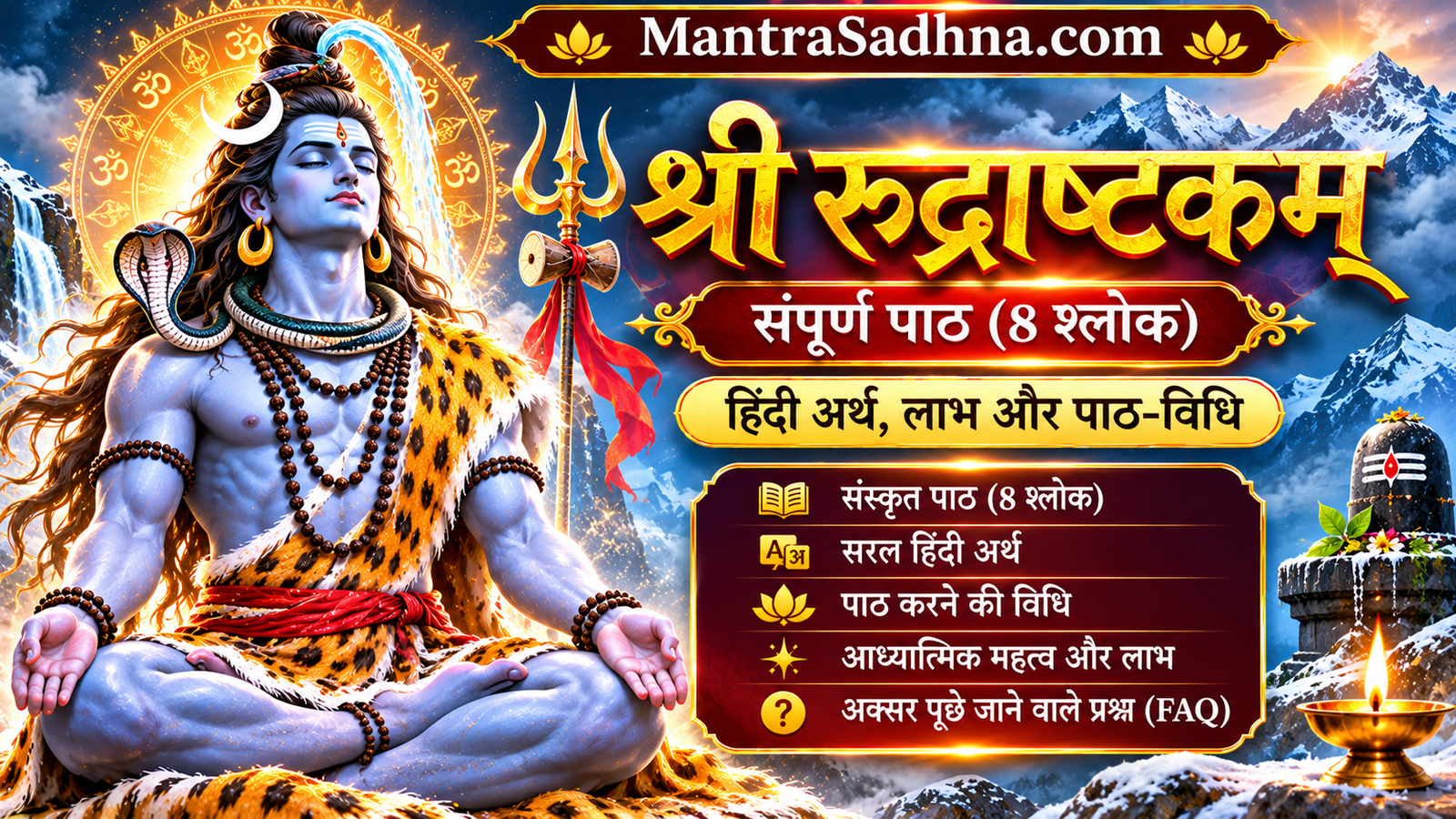
Shri Rudrashtakam – Complete Sanskrit Lyrics with English Meaning
Shri Rudrashtakam (Rudra Ashtakam) is a beautiful eight-verse Sanskrit hymn dedicated to Lord Shiva. Composed by Goswami Tulsidas, it appears in the Uttara Kanda of the Ramcharitmanas.
The hymn celebrates Shiva as the formless Supreme Being, the source of Om, the compassionate Lord of the universe and the divine presence beyond birth, death and ordinary human understanding.
This guide includes the complete Rudrashtakam Sanskrit lyrics, English meanings, spiritual significance, recitation method and frequently asked questions.
Who Wrote Rudrashtakam?
Rudrashtakam was composed by Goswami Tulsidas. In the Ramcharitmanas, the hymn appears in a narrative involving the guru of Kakabhushundi, who praises Lord Shiva.
The name Rudrashtakam combines Rudra, a name of Shiva, and Ashtakam, a composition of eight verses.
Complete Rudrashtakam Lyrics with English Meaning
Verse 1
नमामीशमीशान निर्वाणरूपं।
विभुं व्यापकं ब्रह्मवेदस्वरूपम्॥
निजं निर्गुणं निर्विकल्पं निरीहं।
चिदाकाशमाकाशवासं भजेऽहम्॥१॥
English Meaning: I bow to Lord Shiva, the Lord of all lords, whose nature is liberation. He is all-pervading, the essence of Brahman and the Vedas, beyond attributes, distinctions and desires. I worship the infinite consciousness that transcends physical space.
Verse 2
निराकारमोंकारमूलं तुरीयं।
गिरा ज्ञान गोतीतमीशं गिरीशम्॥
करालं महाकाल कालं कृपालं।
गुणागार संसारपारं नतोऽहम्॥२॥
English Meaning: Shiva is formless, the origin of the sacred sound Om and the transcendent consciousness beyond ordinary experience. He is beyond speech, knowledge and sensory perception. Though formidable and the destroyer of even Time, he is compassionate and beyond worldly existence.
Verse 3
तुषाराद्रि संकाश गौरं गभीरं।
मनोभूत कोटि प्रभा श्री शरीरम्॥
स्फुरन्मौलि कल्लोलिनी चारु गंगा।
लसद्भालबालेन्दु कण्ठे भुजंगा॥३॥
English Meaning: Lord Shiva is radiant like the snow-covered Himalayas, profound and exceedingly beautiful. The sacred Ganga flows through his matted hair, the crescent moon adorns his forehead and serpents rest around his neck.
Verse 4
चलत्कुण्डलं भ्रू सुनेत्रं विशालं।
प्रसन्नाननं नीलकण्ठं दयालम्॥
मृगाधीशचर्माम्बरं मुण्डमालं।
प्रियं शंकरं सर्वनाथं भजामि॥४॥
English Meaning: I worship the beloved Shankara, whose earrings move gracefully, whose eyes are beautiful and wide, and whose face is serene. He is the compassionate blue-throated Lord, wearing a tiger skin and a garland of skulls, the master of all beings.
Verse 5
प्रचण्डं प्रकृष्टं प्रगल्भं परेशं।
अखण्डं अजं भानुकोटिप्रकाशम्॥
त्रयःशूलनिर्मूलनं शूलपाणिं।
भजेऽहं भवानीपतिं भावगम्यम्॥५॥
English Meaning: I worship Shiva, the supreme and mighty Lord, who is indivisible, unborn and radiant like millions of suns. Holding the trident, he is the beloved consort of Bhavani and is approached through sincere devotion.
Verse 6
कलातीत कल्याण कल्पान्तकारी।
सदा सज्जनानन्ददाता पुरारी॥
चिदानन्द सन्दोह मोहापहारी।
प्रसीद प्रसीद प्रभो मन्मथारी॥६॥
English Meaning: O Shiva, you transcend time and its divisions. You are the source of auspiciousness, the power behind cosmic dissolution and the giver of joy to the virtuous. You embody conscious bliss and dispel delusion. O conqueror of Kama, please show your grace.
Verse 7
न यावद् उमानाथ पादारविन्दं।
भजन्तीह लोके परे वा नराणाम्॥
न तावत्सुखं शान्ति सन्तापनाशं।
प्रसीद प्रभो सर्वभूताधिवासम्॥७॥
English Meaning: The poet expresses the devotional belief that lasting peace and relief from suffering arise through worship of Shiva's lotus feet. O Lord of Uma, who dwells within all beings, please be gracious.
Verse 8
न जानामि योगं जपं नैव पूजां।
नतोऽहं सदा सर्वदा शम्भु तुभ्यम्॥
जरा जन्म दुःखौघ तातप्यमानं।
प्रभो पाहि आपन्नमामीश शम्भो॥८॥
English Meaning: O Shambhu, I do not know the elaborate disciplines of yoga, mantra chanting or worship. I simply bow before you at all times. Troubled by the suffering associated with birth, aging and worldly existence, I seek your protection and compassion.
Traditional Concluding Verse (Phalashruti)
रुद्राष्टकमिदं प्रोक्तं विप्रेण हरतोषये।
ये पठन्ति नरा भक्त्या तेषां शम्भुः प्रसीदति॥
English Meaning: This Rudrashtakam was spoken by a Brahmin to please Lord Shiva. According to the traditional concluding verse, Shiva is gracious to those who recite it with devotion.
How to Chant Rudrashtakam
- Choose a quiet, clean place for prayer.
- Sit comfortably before an image or symbol of Lord Shiva if desired.
- Begin with a simple prayer or the remembrance of Om Namah Shivaya.
- Recite the eight verses slowly and clearly.
- Reflect on the meaning of each verse.
- Conclude with a moment of silent contemplation.
Best Time to Recite Rudrashtakam
Monday, Pradosha and Maha Shivaratri are traditionally considered significant for Shiva worship. However, the hymn may be recited on any day according to personal convenience.
One complete recitation can be a meaningful daily practice. Repetition counts are optional and depend on personal devotional traditions.
Spiritual Significance of Rudrashtakam
Shiva as the Formless Supreme
The opening verses describe Shiva as beyond form, attributes and ordinary perception. They invite reflection on the infinite nature of consciousness.
Shiva as the Compassionate Lord
Later verses portray Shiva's recognizable divine form, including the sacred Ganga, crescent moon, serpents and blue throat, while emphasizing his compassion.
Humility and Devotion
The final verse teaches an important devotional lesson: elaborate rituals are not the only expression of faith. Sincere humility and reverence are central to the poet's prayer.
Traditional Benefits of Rudrashtakam
- Encourages regular devotional practice.
- Offers an opportunity to reflect on compassion and humility.
- Supports the practice of Sanskrit reading and memorization.
- Provides a structured period for quiet contemplation.
- Helps readers understand the philosophical symbolism of Shiva.
Religious traditions associate Rudrashtakam with Shiva's blessings. Such spiritual beliefs should not be treated as guarantees of medical recovery, financial success or supernatural outcomes.
Important Precautions
- Practice difficult Sanskrit words gradually.
- Use a reliable text to check pronunciation.
- Do not force yourself to memorize the entire hymn immediately.
- Observe appropriate fire safety when using lamps or incense.
- Do not substitute religious practices for necessary medical care or practical responsibilities.
Frequently Asked Questions
1. Who composed Rudrashtakam?
Rudrashtakam was composed by Goswami Tulsidas and appears in the Uttara Kanda of the Ramcharitmanas.
2. How many verses are in Rudrashtakam?
It contains eight principal verses, followed by a traditional concluding verse.
3. Can Rudrashtakam be recited daily?
Yes. It can be part of a regular personal devotional practice.
4. What is the first line of Rudrashtakam?
The hymn begins with "Namamishamishana Nirvanarupam," praising Shiva as the Supreme Lord whose nature is liberation.
5. Can women chant Rudrashtakam?
Yes. Ordinary devotional recitation is not subject to a universal gender-based restriction, although individual traditions may have their own customs.
6. What is the difference between Rudrashtakam and Shiva Tandava Stotram?
Rudrashtakam is an eight-verse hymn by Tulsidas emphasizing Shiva's transcendence, compassion and devotion. Shiva Tandava Stotram is traditionally attributed to Ravana and vividly describes Shiva's cosmic dance.
7. Is a guru required for Rudrashtakam recitation?
Formal initiation is not universally required for ordinary devotional recitation. A knowledgeable teacher may help with accurate pronunciation.
Conclusion
Shri Rudrashtakam is a profound expression of devotion to Lord Shiva. Its eight verses unite philosophical reflection with a heartfelt prayer for compassion. Reading the Sanskrit text alongside its meaning can help devotees appreciate the depth of this timeless hymn.
Har Har Mahadev. Om Namah Shivaya.