 Mantra
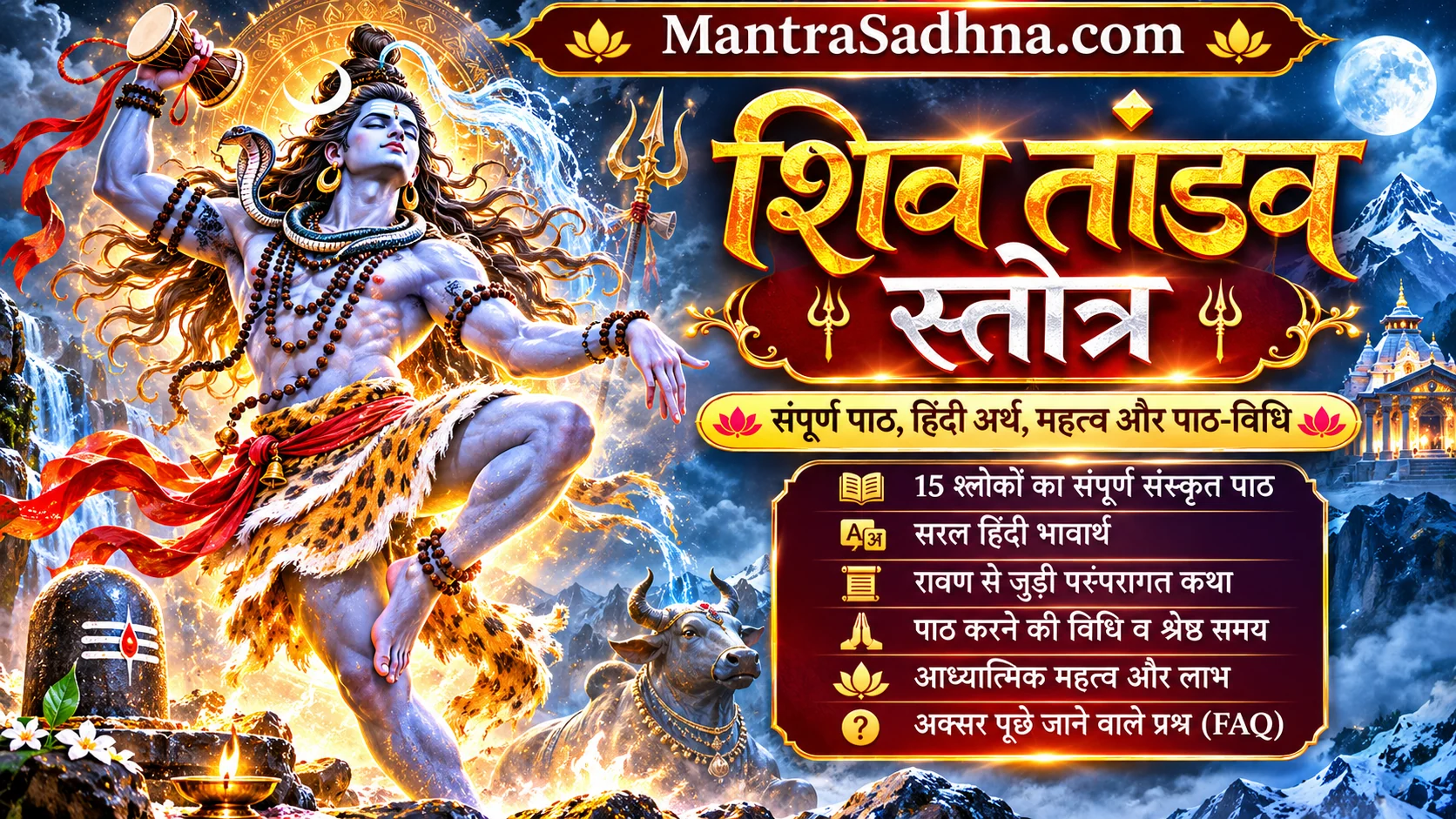
Shiva Tandava Stotram – Complete Sanskrit Lyrics, English Meaning and Chanting Guide
Shiva Tandava Stotram is a celebrated Sanskrit hymn describing Lord Shiva's majestic cosmic dance, known as Tandava. Its powerful rhythm evokes the sound of Shiva's damaru, the movement of the sacred Ganga through his matted locks, the crescent moon on his head and the fire shining upon his forehead.
Traditionally attributed to Ravana, the hymn is admired for its energetic poetic structure, elaborate Sanskrit compounds and vivid devotional imagery.
Textual note: This guide presents a commonly recited 15-verse version. Some traditional editions preserve different readings and additional verses.
Who Composed the Shiva Tandava Stotram?
According to a popular religious tradition, Ravana composed this hymn in praise of Lord Shiva. The story recounts Ravana attempting to lift Mount Kailasa. Shiva pressed the mountain down with his toe, humbling Ravana, who then praised the Lord.
This is a traditional devotional account rather than independently established historical evidence of authorship.
Complete Shiva Tandava Stotram – Sanskrit Verses with English Meanings
Verse 1
जटाटवीगलज्जलप्रवाहपावितस्थले
गलेऽवलम्ब्य लम्बितां भुजङ्गतुङ्गमालिकाम् ।
डमड्डमड्डमड्डमन्निनादवड्डमर्वयं
चकार चण्डताण्डवं तनोतु नः शिवः शिवम् ॥१॥
Meaning: The sacred Ganga flows through Shiva's matted locks, serpents adorn his neck, and his damaru resounds as he performs the mighty Tandava. May Lord Shiva bestow auspiciousness upon us.
Verse 2
जटाकटाहसम्भ्रमभ्रमन्निलिम्पनिर्झरी-
विलोलवीचिवल्लरीविराजमानमूर्धनि ।
धगद्धगद्धगज्ज्वलल्ललाटपट्टपावके
किशोरचन्द्रशेखरे रतिः प्रतिक्षणं मम ॥२॥
Meaning: The waves of the heavenly Ganga move through Shiva's hair. Fire blazes upon his forehead while the young crescent moon adorns his head. May my devotion to him remain constant.
Verse 3
धराधरेन्द्रनन्दिनीविलासबन्धुबन्धुर-
स्फुरद्दिगन्तसन्ततिप्रमोदमानमानसे ।
कृपाकटाक्षधोरणीनिरुद्धदुर्धरापदि
क्वचिद्दिगम्बरे मनो विनोदमेतु वस्तुनि ॥३॥
Meaning: Shiva is the beloved companion of Parvati, daughter of the mountain king. His gracious glance is celebrated as a source of relief from adversity. May my mind delight in his divine presence.
Verse 4
जटाभुजङ्गपिङ्गलस्फुरत्फणामणिप्रभा-
कदम्बकुङ्कुमद्रवप्रलिप्तदिग्वधूमुखे ।
मदान्धसिन्धुरस्फुरत्त्वगुत्तरीयमेदुरे
मनो विनोदमद्भुतं बिभर्तु भूतभर्तरि ॥४॥
Meaning: The jewels on the hoods of serpents in Shiva's hair shine brilliantly. Wearing an elephant hide, the Lord of all beings appears in a remarkable form. May contemplation of him bring spiritual delight.
Verse 5
सहस्रलोचनप्रभृत्यशेषलेखशेखर-
प्रसूनधूलिधोरणीविधूसराङ्घ्रिपीठभूः ।
भुजङ्गराजमालया निबद्धजाटजूटकः
श्रियै चिराय जायतां चकोरबन्धुशेखरः ॥५॥
Meaning: The flowers offered by Indra and other celestial beings adorn Shiva's feet. A serpent king binds his matted hair, and the moon rests upon his head. May this Lord grant enduring auspiciousness.
Verse 6
ललाटचत्वरज्वलद्धनञ्जयस्फुलिङ्गभा-
निपीतपञ्चसायकं नमन्निलिम्पनायकम् ।
सुधामयूखलेखया विराजमानशेखरं
महाकपालिसम्पदेशिरोजटालमस्तु नः ॥६॥
Meaning: The blazing fire of Shiva's forehead consumed the five arrows of Kama, the god of desire. Celestial beings bow before Shiva, whose head shines with the cooling crescent moon. May his presence bring blessings.
Verse 7
करालफालपट्टिकाधगद्धगद्धगज्ज्वल-
द्धनञ्जयाधरीकृतप्रचण्डपञ्चसायके ।
धराधरेन्द्रनन्दिनीकुचाग्रचित्रपत्रक-
प्रकल्पनैकशिल्पिनि त्रिलोचने मतिर्मम ॥७॥
Meaning: Shiva's fierce third-eye fire overcomes the power of desire, yet he is also portrayed in a tender and affectionate relationship with Parvati. May my thoughts remain devoted to the three-eyed Lord.
Verse 8
नवीनमेघमण्डलीनिरुद्धदुर्धरस्फुरत्-
कुहूनिशीथिनीतमःप्रबन्धबन्धुकन्धरः ।
निलिम्पनिर्झरीधरस्तनोतु कृत्तिसिन्धुरः
कलानिधानबन्धुरः श्रियं जगद्धुरन्धरः ॥८॥
Meaning: Shiva's dark throat resembles the deep darkness of a moonless night. He bears the heavenly river, wears an elephant hide and is adorned with the moon. May the sustainer of the universe grant auspiciousness.
Verse 9
प्रफुल्लनीलपङ्कजप्रपञ्चकालिमप्रभा-
विलम्बिकण्ठकन्दलीरुचिप्रबद्धकन्धरम् ।
स्मरच्छिदं पुरच्छिदं भवच्छिदं मखच्छिदं
गजच्छिदान्धकच्छिदं तमन्तकच्छिदं भजे ॥९॥
Meaning: I worship Shiva, whose throat is dark like a blooming blue lotus. He is praised as the destroyer of Kama, Tripura, Andhaka and the fear of death, expressing his power over attachment and destructive forces.
Verse 10
अखर्वसर्वमङ्गलाकलाकदम्बमञ्जरी-
रसप्रवाहमाधुरीविजृम्भणामधुव्रतम् ।
स्मरान्तकं पुरान्तकं भवान्तकं मखान्तकं
गजान्तकान्धकान्तकं तमन्तकान्तकं भजे ॥१०॥
Meaning: Shiva is poetically compared to a bee enjoying the sweetness of every auspicious art. The verse again praises his power over desire, destructive pride and the limitations of worldly existence.
Verse 11
जयत्वदभ्रविभ्रमभ्रमद्भुजङ्गमश्वस-
द्विनिर्गमत्क्रमस्फुरत्करालभालहव्यवाट् ।
धिमिद्धिमिद्धिमिध्वनन्मृदङ्गतुङ्गमङ्गल-
ध्वनिक्रमप्रवर्तितप्रचण्डताण्डवः शिवः ॥११॥
Meaning: Serpents move around Shiva as fire blazes upon his forehead. The mighty sound of the mridanga accompanies his powerful Tandava. Victory to Lord Shiva!
Verse 12
दृषद्विचित्रतल्पयोर्भुजङ्गमौक्तिकस्रजोर्-
गरिष्ठरत्नलोष्ठयोः सुहृद्विपक्षपक्षयोः ।
तृष्णारविन्दचक्षुषोः प्रजामहीमहेन्द्रयोः
समप्रवृत्तिकः कदा सदाशिवं भजे ॥१२॥
Meaning: When shall I worship Shiva with an equal mind toward a stone and a luxurious bed, a serpent and a pearl necklace, a jewel and a lump of clay, a friend and an enemy, and an ordinary person and a king? This verse celebrates equanimity.
Verse 13
कदा निलिम्पनिर्झरीनिकुञ्जकोटरे वसन्
विमुक्तदुर्मतिः सदा शिरःस्थमञ्जलिं वहन् ।
विमुक्तलोललोचनो ललामभाललग्नकः
शिवेति मन्त्रमुच्चरन् कदा सुखी भवाम्यहम् ॥१३॥
Meaning: The poet longs to dwell near the sacred Ganga, free from harmful thoughts and restless distractions, with folded hands and the name of Shiva upon his lips, experiencing inner contentment.
Verse 14
इदं हि नित्यमेवमुक्तमुत्तमोत्तमं स्तवं
पठन्स्मरन्ब्रुवन्नरो विशुद्धिमेति सन्ततम् ।
हरे गुरौ सुभक्तिमाशु याति नान्यथा गतिं
विमोहनं हि देहिनां सुशङ्करस्य चिन्तनम् ॥१४॥
Meaning: The traditional concluding praise states that regular recitation and remembrance of this hymn cultivate purity and devotion to Lord Shiva. This is a devotional assertion, not a scientifically established guarantee.
Verse 15
पूजावसानसमये दशवक्त्रगीतं
यः शम्भुपूजनपरं पठति प्रदोषे ।
तस्य स्थिरां रथगजेन्द्रतुरङ्गयुक्तां
लक्ष्मीं सदैव सुमुखीं प्रददाति शम्भुः ॥१५॥
Meaning: The concluding verse traditionally promises prosperity to devotees who recite Ravana's hymn during Shiva worship at Pradosha. This should be understood as religious praise rather than a guaranteed financial outcome.
How to Chant Shiva Tandava Stotram
- Choose a clean and peaceful place.
- Sit comfortably before an image or symbol of Lord Shiva if you wish.
- Begin with a respectful prayer.
- Read the Sanskrit verses slowly, paying attention to pronunciation.
- Use a reliable text and practice difficult compound words in smaller sections.
- Reflect upon the meaning of each verse.
- Conclude with a short period of silent contemplation.
Best Time for Recitation
Monday, Pradosha and Maha Shivaratri are traditionally associated with Shiva worship. However, a devotee may read this hymn at any convenient time.
Reciting the complete hymn once can be a meaningful daily practice. Additional repetitions are optional and depend on personal preference or tradition.
Spiritual Symbolism of Shiva's Tandava
- Tandava: Cosmic movement, transformation and divine power.
- Damaru: Rhythm, sacred sound and creative expression.
- Ganga: Purification and continuous spiritual flow.
- Crescent Moon: Calmness and balance.
- Third Eye: Wisdom, insight and the destruction of ignorance.
- Equanimity: A balanced attitude toward pleasure, difficulty, wealth and status.
Traditional Benefits of Shiva Tandava Stotram
Devotees recite this hymn to express reverence for Shiva and to strengthen their devotional discipline. Regular, attentive recitation may help some people practice concentration, memorization and Sanskrit pronunciation.
Traditional religious texts associate the hymn with auspiciousness and divine blessings. Such beliefs should not be presented as guaranteed cures, financial rewards or supernatural results.
Important Precautions
- Do not rush through difficult Sanskrit words.
- Use a trusted printed or digital text to check pronunciation.
- There is no need to memorize all verses immediately.
- Avoid straining your voice during prolonged recitation.
- Use lamps and incense safely.
- Do not replace medical treatment or practical responsibilities with devotional practices.
Frequently Asked Questions
1. Who wrote the Shiva Tandava Stotram?
The hymn is traditionally attributed to Ravana, the king of Lanka.
2. Can Shiva Tandava Stotram be chanted daily?
Yes. It can be included in a regular personal devotional routine.
3. Can women recite Shiva Tandava Stotram?
Yes. There is no universal gender-based restriction on ordinary devotional recitation, although individual religious traditions may have different customs.
4. Is a guru necessary for recitation?
Formal initiation is not universally required for ordinary devotional reading of this hymn. A knowledgeable teacher can help with pronunciation.
5. How many verses are in Shiva Tandava Stotram?
This article presents a commonly circulated 15-verse version. Other textual traditions may differ.
6. What is the main message of Shiva Tandava Stotram?
The hymn celebrates Shiva's cosmic power, divine beauty, spiritual symbolism and the ideal of inner equanimity.
Conclusion
The Shiva Tandava Stotram combines rhythmic Sanskrit poetry with vivid images of Lord Shiva's divine dance. Studying its meaning alongside regular recitation can make the experience more thoughtful and personally meaningful.
Har Har Mahadev. Om Namah Shivaya.