 Mantra
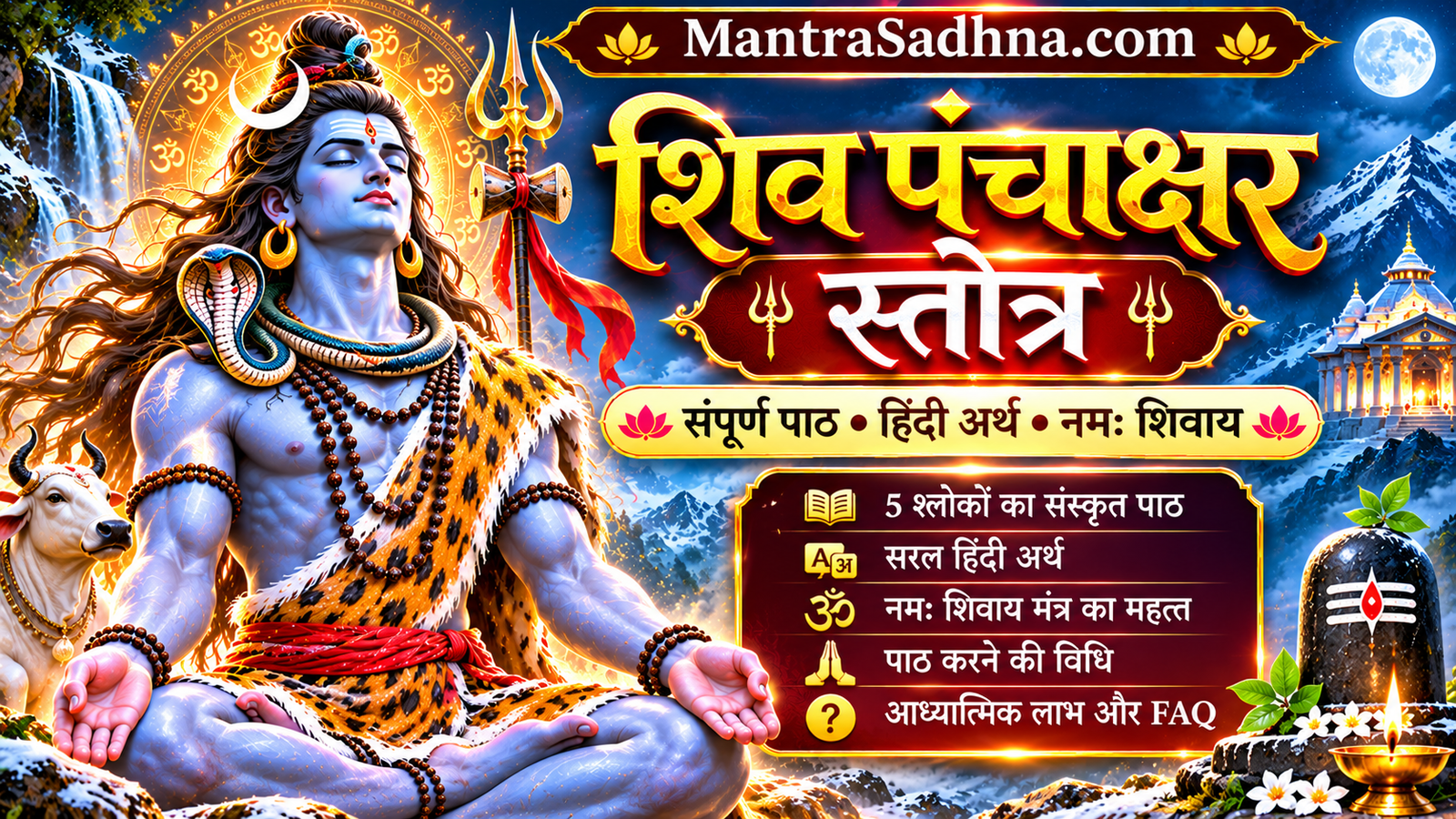
Shiva Panchakshara Stotram – Complete Sanskrit Lyrics with English Meaning
Shiva Panchakshara Stotram is a celebrated Sanskrit hymn dedicated to Lord Shiva. It is based on the five sacred syllables of the mantra Namah Shivaya: Na, Ma, Shi, Va and Ya.
Each of the five principal verses praises a particular aspect of Lord Shiva and concludes by honoring the corresponding syllable of the Panchakshari mantra.
The hymn is traditionally attributed to Adi Shankaracharya and begins with the famous words Nagendraharaya Trilochanaya.
In this guide, you can read the complete Sanskrit verses, their English meanings, spiritual symbolism, traditional significance, chanting instructions and frequently asked questions.
What Is Shiva Panchakshara Stotram?
The Sanskrit term Panchakshara means "five syllables." The mantra Namah Shivaya consists of five sacred syllables in traditional Sanskrit analysis.
When Om is added before Namah Shivaya, the resulting mantra is commonly described as Shadakshari, or six-syllabled.
The Shiva Panchakshara Stotram connects these syllables with the divine attributes of Shiva, including his three eyes, sacred ash, serpents, the river Ganga, the crescent moon and his timeless nature.
Complete Shiva Panchakshara Stotram – Five Sanskrit Verses
Verse 1 – Na
नागेन्द्रहाराय त्रिलोचनाय
भस्माङ्गरागाय महेश्वराय।
नित्याय शुद्धाय दिगम्बराय
तस्मै नकाराय नमः शिवाय॥१॥
English Meaning: Salutations to Lord Shiva, who wears the king of serpents as a garland, possesses three eyes, adorns his body with sacred ash and is the great Lord. He is eternal, pure and clothed in the directions themselves. I bow to Shiva, represented by the syllable Na.
Spiritual reflection: This verse celebrates purity, detachment and Shiva's eternal nature.
Verse 2 – Ma
मन्दाकिनीसलिलचन्दनचर्चिताय
नन्दीश्वरप्रमथनाथमहेश्वराय।
मन्दारपुष्पबहुपुष्पसुपूजिताय
तस्मै मकाराय नमः शिवाय॥२॥
English Meaning: Salutations to Shiva, who is worshipped with the sacred waters of the Mandakini and sandalwood paste. He is the Lord of Nandi and the divine attendants and is honored with Mandara flowers and many other blossoms. I bow to Shiva, represented by the syllable Ma.
Spiritual reflection: This verse emphasizes devotion, purity and heartfelt offerings.
Verse 3 – Shi
शिवाय गौरीवदनाब्जवृन्द-
सूर्याय दक्षाध्वरनाशकाय।
श्रीनीलकण्ठाय वृषध्वजाय
तस्मै शिकाराय नमः शिवाय॥३॥
English Meaning: Salutations to Shiva, who is like the sun bringing joy to the lotus-like face of Goddess Gauri. He is the destroyer of Daksha's sacrifice, the blue-throated Lord and the one whose banner bears the symbol of a bull. I bow to Shiva, represented by the syllable Shi.
Spiritual reflection: This verse portrays Shiva as both compassionate and a defender of righteousness.
Verse 4 – Va
वसिष्ठकुम्भोद्भवगौतमार्य-
मुनीन्द्रदेवार्चितशेखराय।
चन्द्रार्कवैश्वानरलोचनाय
तस्मै वकाराय नमः शिवाय॥४॥
English Meaning: Salutations to Lord Shiva, whose head is worshipped by great sages such as Vashistha, Agastya and Gautama, along with celestial beings. His three eyes are symbolically identified with the moon, sun and fire. I bow to Shiva, represented by the syllable Va.
Spiritual reflection: This verse associates Shiva with wisdom, illumination and spiritual insight.
Verse 5 – Ya
यज्ञस्वरूपाय जटाधराय
पिनाकहस्ताय सनातनाय।
दिव्याय देवाय दिगम्बराय
तस्मै यकाराय नमः शिवाय॥५॥
English Meaning: Salutations to Shiva, the embodiment of sacred sacrifice, who wears matted locks, holds the Pinaka bow and is eternal. He is the divine Lord, clothed in the directions themselves. I bow to Shiva, represented by the syllable Ya.
Spiritual reflection: This verse celebrates the eternal and transcendent nature of Shiva.
Traditional Concluding Verse – Phalashruti
पञ्चाक्षरमिदं पुण्यं यः पठेच्छिवसन्निधौ।
शिवलोकमवाप्नोति शिवेन सह मोदते॥
English Meaning: According to the traditional concluding verse, a person who recites this sacred five-syllabled hymn in the presence of Lord Shiva attains Shiva's realm and experiences divine joy in his presence.
This is a traditional religious statement about spiritual merit rather than a scientifically verifiable promise.
The Meaning of the Five Syllables of Namah Shivaya
In several Shaiva traditions, the five syllables are associated with the five great elements:
- Na: Earth.
- Ma: Water.
- Shi: Fire.
- Va: Air.
- Ya: Space.
These associations are traditional spiritual interpretations. Their significance and philosophical explanation may vary between Shaiva schools.
How to Recite Shiva Panchakshara Stotram
- Choose a clean, peaceful place for prayer.
- Sit comfortably before an image or symbol of Lord Shiva if desired.
- Begin with a respectful prayer.
- Read the five Sanskrit verses slowly and clearly.
- Reflect on the meaning of each verse.
- Conclude with a short remembrance of Om Namah Shivaya.
- Spend a few moments in quiet contemplation.
Best Time for Recitation
Monday, Pradosha and Maha Shivaratri are traditionally associated with Shiva worship. However, devotees may recite Shiva Panchakshara Stotram at any convenient time.
One complete recitation of the five verses may form a simple daily devotional routine. Additional repetitions are optional.
Spiritual Significance of Shiva Panchakshara Stotram
Devotion to Lord Shiva
The hymn brings together familiar symbols of Shiva and the sacred Panchakshari mantra, making it an accessible expression of devotion.
Reflection on the Five Elements
Traditional interpretations of the mantra invite contemplation of the relationship between nature, consciousness and the divine.
Humility and Detachment
Shiva's ash-covered body, matted hair and simple appearance symbolize freedom from attachment to worldly luxury.
Traditional Benefits of Shiva Panchakshara Stotram
- Encourages regular devotional discipline.
- Provides an opportunity to practice Sanskrit pronunciation.
- Helps readers understand traditional symbols of Shiva.
- Supports quiet reflection and attentive recitation.
- Encourages contemplation of purity, humility and detachment.
Religious tradition associates the hymn with Shiva's blessings and spiritual welfare. These beliefs should not be presented as guaranteed medical, financial or supernatural outcomes.
Important Precautions
- Use a reliable Sanskrit text for pronunciation.
- Learn difficult words gradually.
- There is no need to memorize all verses immediately.
- Use lamps and incense safely.
- Do not replace necessary medical care or practical responsibilities with devotional practices.
Frequently Asked Questions
1. Who composed Shiva Panchakshara Stotram?
The hymn is traditionally attributed to Adi Shankaracharya. Independent historical evidence concerning its exact date and authorship is limited.
2. How many verses are in Shiva Panchakshara Stotram?
It contains five principal verses, followed by a traditional concluding verse.
3. What is the first line of Shiva Panchakshara Stotram?
The hymn begins with "Nagendraharaya Trilochanaya," praising Shiva as the three-eyed Lord adorned with serpents.
4. Can Shiva Panchakshara Stotram be recited daily?
Yes. It can be included in a regular personal devotional routine.
5. Can women recite Shiva Panchakshara Stotram?
Yes. There is no universal gender-based restriction on ordinary devotional recitation, although individual traditions may have different customs.
6. What is the difference between Panchakshari and Shadakshari mantras?
Namah Shivaya is the five-syllabled Panchakshari mantra. When Om is added before it, the mantra is commonly called Shadakshari.
7. Is a guru necessary to recite the hymn?
Formal initiation is not universally required for ordinary devotional reading. Specific mantra initiations or lineage-based practices may follow different rules.
8. Is Shiva Panchakshara Stotram the same as Shiva Tandava Stotram?
No. Shiva Panchakshara Stotram is organized around the five syllables of Namah Shivaya, while Shiva Tandava Stotram celebrates Shiva's powerful cosmic dance.
Conclusion
Shiva Panchakshara Stotram is a concise and meaningful Sanskrit hymn that celebrates Lord Shiva through the five sacred syllables of Namah Shivaya. Understanding the verses while reciting them can deepen appreciation of Shiva's spiritual symbolism and devotional traditions.
Har Har Mahadev. Om Namah Shivaya.