 Mantra
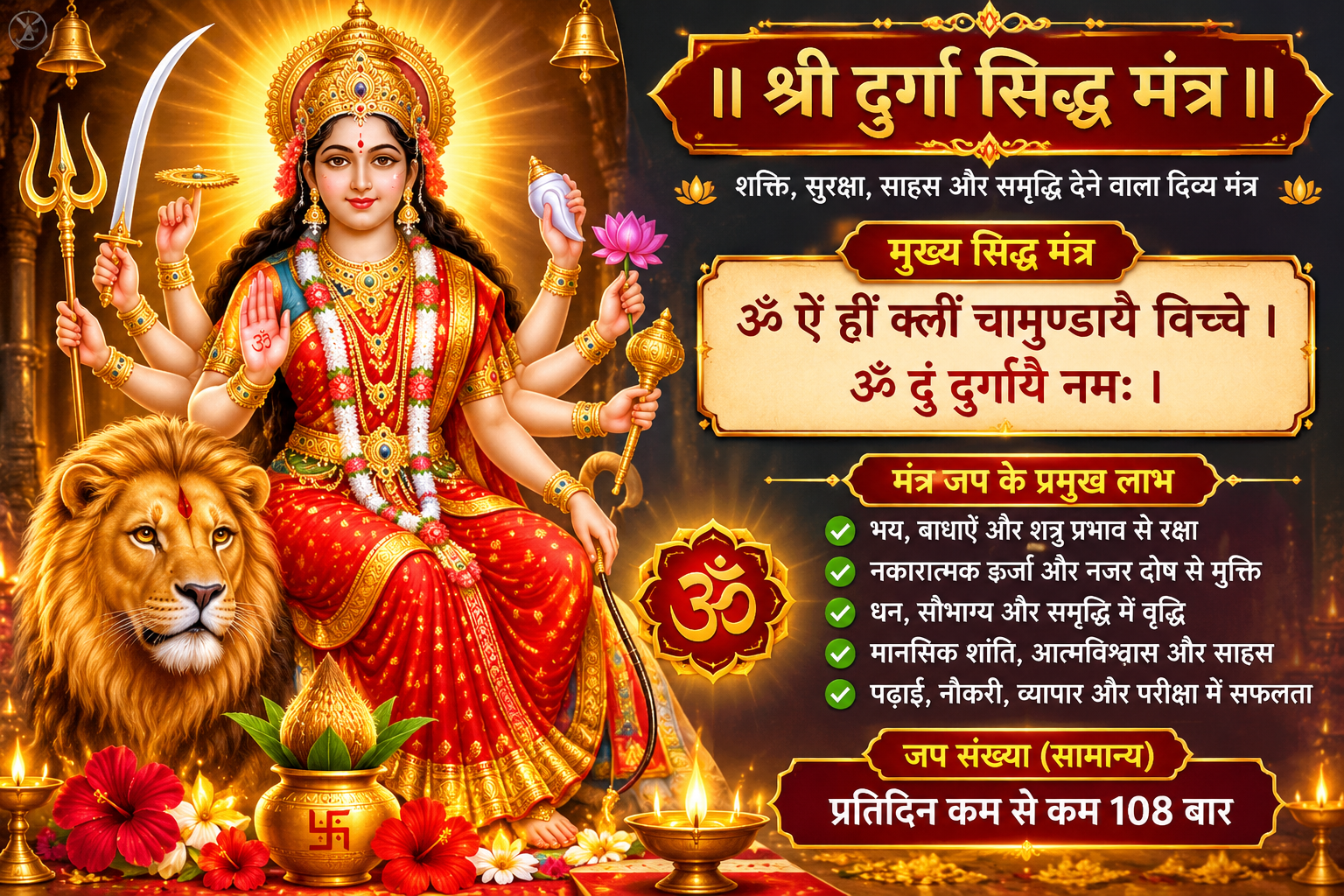
Shri Durga Siddhi Mantra: Complete Mantras, Chanting Method, Benefits and Rules
Goddess Durga is worshipped in Hindu traditions as Adi Shakti, Jagadamba, Bhavani, Mahishasuramardini and the Divine Mother. Her worship symbolizes courage, wisdom, compassion, protection and the strength to face life's challenges.
The expression Shri Durga Siddha Mantra is commonly used for devotional collections containing mantras associated with Goddess Durga, Chamunda, Katyayani and other forms of the Divine Mother.
This guide explains the principal Durga mantras, their meanings, worship materials, daily chanting procedure, Navratri practice, traditional benefits and important precautions.
1. Spiritual Significance of Durga Mantra
In Shakta traditions, Goddess Durga represents divine energy and the triumph of righteousness over harmful tendencies. Devotees chant her mantras as expressions of devotion and prayers for inner strength, clarity and spiritual protection.
Regular chanting may serve as a structured spiritual routine. Experiences differ between individuals and traditions, and no particular result should be considered guaranteed.
2. Main Shri Durga Siddha Mantras
ॐ ऐं ह्रीं क्लीं चामुण्डायै विच्चे॥
ॐ दुं दुर्गायै नमः॥
The first is commonly called the Navarna Mantra and is associated with Goddess Chamunda. The second is a concise Durga mantra containing the seed syllable Dum.
Some traditions recommend initiation or guidance for formal Navarna Mantra rituals. General devotional practice may begin with a simple Durga name-mantra.
3. Meaning of the Navarna Mantra
Om: The sacred primordial syllable.
Aim: Traditionally associated with knowledge and divine speech.
Hrim: Associated with divine consciousness and spiritual energy.
Klim: Interpreted in some traditions as a seed syllable associated with love, attraction and divine power.
Chamundayai: An invocation of Goddess Chamunda.
Vichche: A distinctive component of the Navarna Mantra, interpreted differently across traditions.
The overall devotional significance is a prayer for courage, wisdom, inner clarity and spiritual strength.
4. Extended Collection of Durga Prayers
Part One - Sarva Mangala Mangalye Prayer
सर्वमङ्गलमाङ्गल्ये शिवे सर्वार्थसाधिके।
शरण्ये त्र्यम्बके गौरि नारायणि नमोऽस्तु ते॥
Meaning: Salutations to the auspicious Divine Mother, who embodies well-being, grants refuge and is revered as Gauri and Narayani.
Part Two - Popular Durga Stuti
ॐ दुर्गे दुर्गटे देवी, दुःख दारिद्र्य नाशिनी।
शत्रु संहारिणी दिव्ये, दुर्गा देवि नमोऽस्तुते॥
This is a popular devotional version preserved from the supplied text. Its wording may vary between local prayer collections and should not be presented as a verified Vedic verse.
Part Three - Katyayani Mantra
कात्यायनि महामाये महायोगिन्यधीश्वरि।
नन्दगोपसुतं देवि पतिं मे कुरु ते नमः॥
This prayer appears in the context of Srimad Bhagavata Purana, Canto 10, Chapter 22, where the worship of Katyayani is associated with a prayer to obtain Lord Krishna as a husband.
Part Four - Short Goddess Mantras
ॐ ह्रीं दुर्गायै नमः॥
ॐ ऐं सरस्वत्यै नमः॥
ॐ क्लीं महालक्ष्म्यै नमः॥
These short forms are associated with devotional remembrance of Durga, Saraswati and Mahalakshmi. Their ritual interpretations and usage may differ by lineage.
Part Five - Combined Devotional Invocation
ॐ ऐं ह्रीं क्लीं चामुण्डायै विच्चे।
ॐ दुं दुर्गायै नमः।
दुर्गे दुर्गतहारिणि स्वाहा॥
This combines multiple devotional phrases. It should be understood as a composite prayer rather than a single established scriptural mantra.
5. Traditional Benefits of Durga Mantra Chanting
According to devotional traditions, worshippers chant Durga mantras while seeking:
- Courage and determination during difficult situations.
- Concentration and self-confidence.
- Spiritual reassurance and divine blessings.
- Family harmony, patience and kindness.
- Discipline in education, work and daily responsibilities.
- Prosperity and well-being through prayer and responsible effort.
- Wisdom to overcome obstacles with patience and practical judgment.
Chanting cannot be guaranteed to prevent accidents, cure illness, eliminate enemies, win legal disputes or produce financial success. Such expectations belong to religious belief rather than established evidence.
6. Materials for Durga Puja
- A clean image or idol of Goddess Durga.
- A comfortable sitting mat.
- A safely placed oil or ghee lamp.
- Fresh flowers, if available.
- Clean water.
- Optional incense.
- A mala or counter for counting repetitions.
- Fruit or simple offerings.
All these items are optional for ordinary devotional chanting. Sincere prayer can be performed without elaborate materials.
7. Step-by-Step Durga Mantra Chanting Method
Step 1 - Prepare the Space
Choose a clean and peaceful location. Wear comfortable, clean clothing and sit in a relaxed posture.
Step 2 - Remember Goddess Durga
Place an image or idol of the Goddess before you if desired. Join your hands and begin with a respectful prayer.
Step 3 - Light a Lamp
Light a lamp in a safe place if appropriate. Recite the following mantra three times:
ॐ दुं दुर्गायै नमः॥
Step 4 - Make a Personal Intention
O Divine Mother Durga, may this prayer inspire courage, clarity, compassion, peace and the strength to act responsibly.
Step 5 - Chant the Mantra
For simple daily worship, repeat the Durga mantra 11, 21 or 108 times:
ॐ दुं दुर्गायै नमः॥
If you follow a tradition involving the Navarna Mantra, use the pronunciation, repetition count and guidance appropriate to that tradition.
ॐ ऐं ह्रीं क्लीं चामुण्डायै विच्चे॥
Chant calmly, pronounce each syllable carefully and focus on the devotional meaning rather than speed.
Step 6 - Complete the Prayer
After chanting, sit quietly for a few moments, offer gratitude and resolve to practice honesty, kindness and discipline.
8. Chanting Counts and Practice Duration
- 11 repetitions: A short daily prayer.
- 21 repetitions: A simple regular practice.
- 108 repetitions: A traditional mala count.
- 9 days: A devotional routine during Navratri.
- 21 days: A personal consistency practice.
- 41 days: A longer personal devotional routine.
These durations may help build consistency. They do not guarantee mantra siddhi or specific outcomes.
9. Auspicious Times and Directions
Morning, evening, Tuesdays, Fridays and Navratri are traditionally associated with Goddess worship. Some practitioners face east or north while chanting.
For ordinary devotion, a fixed time or direction is not essential. A sustainable routine matters more than elaborate arrangements.
10. Durga Mantra During Navratri
Navratri is a major Hindu festival dedicated to the nine forms of Goddess Durga. Devotees may recite prayers, perform simple puja, offer flowers and practice mantra meditation during the nine days.
Fasting is optional. People with medical conditions, pregnant individuals and anyone taking medication should follow appropriate medical advice rather than undertaking restrictive fasting without guidance.
11. Meditation and Visualization
Devotees may visualize Goddess Durga as a compassionate, radiant presence seated upon a lion. Focus on the meaning of the prayer rather than trying to force unusual experiences.
If attention wanders, gently return to the mantra. Special visions, sensations or sounds are not necessary for meaningful devotional practice.
12. Rules and Precautions
- Never use religious practice to threaten, intimidate or harm others.
- Seek qualified traditional guidance for advanced rituals.
- Keep lamps and incense away from flammable materials.
- Avoid turning chanting into a source of fear, guilt or compulsion.
- Continue appropriate medical, legal, psychological or financial support when needed.
- Rest or shorten the practice if you feel uncomfortable.
13. Closing Prayer
O Mother Durga,
Grant me courage in moments of fear.
Patience in times of difficulty.
Wisdom when making decisions.
And compassion in my actions.
May peace and harmony flourish in my home.
Jai Mata Di.
14. Frequently Asked Questions
Q1. What is the Shri Durga Siddha Mantra?
Two well-known devotional mantras are Om Dum Durgayai Namah and the Navarna Mantra Om Aim Hrim Klim Chamundayai Vichche. Their ritual traditions may differ.
Q2. Can I chant a Durga mantra every day?
Yes. A simple Durga name-mantra can be used for regular devotional prayer. Advanced rituals may have additional requirements.
Q3. Is chanting 108 times mandatory?
No. While 108 is a traditional count, simple devotional practice may involve 11 or 21 repetitions.
Q4. Can I chant without a mala?
Yes. A mala helps count repetitions but is not required for ordinary prayer.
Q5. Does Durga mantra remove negative energy?
In religious traditions, the Goddess is revered as a protector. Chanting may provide spiritual comfort, but claims about supernatural effects are matters of belief rather than established scientific facts.
Q6. Can women chant Durga mantras?
Yes. General devotional prayer is open to worshippers. Particular ritual lineages may have their own customs.
Q7. Will chanting guarantee money or career success?
No. Spiritual practice may support motivation and discipline, while outcomes depend on skills, effort, opportunities and practical decisions.
Q8. Is Navratri considered special for Durga chanting?
Yes. Navratri is one of the principal festivals of Goddess worship, and many devotees increase their prayers and chanting during this period.
15. Conclusion
Shri Durga Siddha Mantra represents a devotional path centered on courage, spiritual reflection, discipline and reverence for the Divine Mother. Beginners can start with simple prayers, while advanced practitioners may follow their established spiritual tradition.
Spiritual devotion is best practiced alongside responsible action, practical judgment and care for personal well-being.
॥ Jai Mata Di ॥
Disclaimer: This article is intended for religious, cultural and educational purposes. It does not guarantee supernatural protection, healing, financial success or any other specific result.